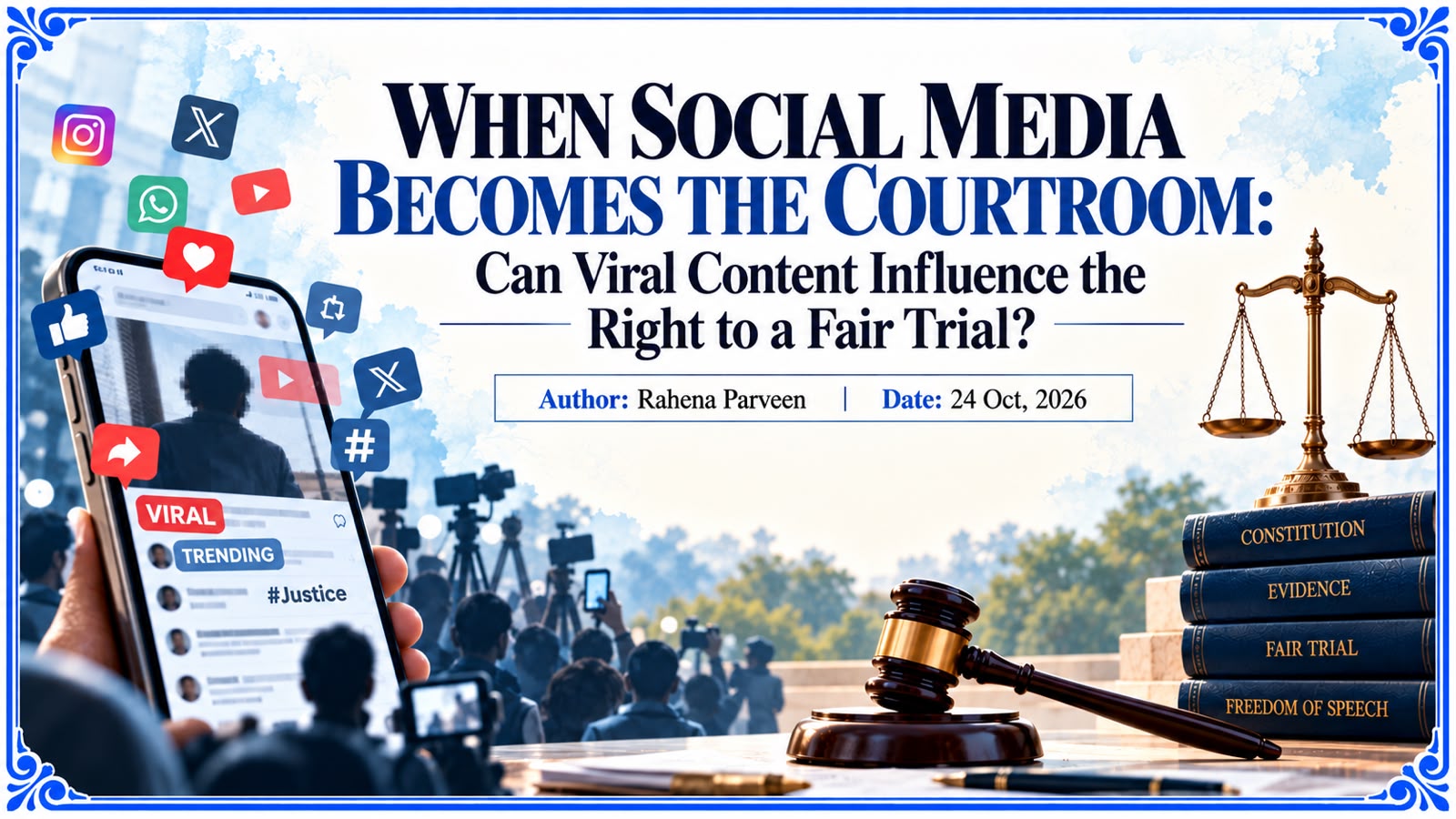
WHEN SOCIAL MEDIA BECOMES THE COURTROOM: CAN VIRAL CONTENT INFLUENCE THE RIGHT TO A FAIR TRIAL?
Author: Rahena Parveen | Date: 24 Oct, 2026
INTRODUCTION
In today's digital world, a person can be accused, judged and even declared guilty on social media before a court has had the opportunity to examine the case. A short video, Instagram post, WhatsApp message or trending hashtag can spread within minutes. Sometimes, people form strong opinions about an incident without knowing the complete facts or waiting for the investigation to finish. This raises an important legal question: Can viral social-media content affect a person's right to a fair trial? The issue is not about stopping people from expressing their opinions. Freedom of speech is an important constitutional right. The concern is whether social-media discussions can go so far that they create prejudice against an accused person, influence witnesses or put pressure on the justice system. In India, this question becomes particularly important because the Constitution protects both freedom of speech under Article 19(1)(a) and the right to life and personal liberty under Article 21, which includes the right to a fair trial.
THE CONSTITUTIONAL RIGHT TO A FAIR TRIAL
The Indian Constitution does not expressly use the words “right to fair trial” in Article 21 . However ,the Supreme Court has repeatedly emphasised that criminal proceedings must be fair, impartial and conducted according to law. In Zahira Habibulla H. Sheikh v. State of Gujarat, (2004) , the Supreme Court stressed that a fair trial requires an impartial judge, a fair prosecutor and an atmosphere in which justice can be properly administered. The principle of fairness applies to everyone involved in a criminal proceeding, including the accused, the victim and witnesses. Article 14 is also relevant because it guarantees equality before law, while Article 19(1)(a) protects freedom of speech and expression. Therefore, the issue is not about choosing one constitutional right over another. The real challenge is finding a balance between free expression and a fair administration of justice.
WHAT HAPPENS WHEN PUBLIC OPINION BECOMES A JUDGMENT?
When public opinion replaces a legal verdict, it triggers a "Trial by Social Media" , where an accused person is declared guilty by the public before evidence is ever tested in court.
- It destroys the core principle of "innocent until proven guilty" and prejudices the right to a fair,unbiased trial.
- The outrage frequently spills over, targeting innocent family members with online abuse and real-world safety threats.
In Sidhartha Vashisht @ Manu Sharma v. State (NCT of Delhi), (2010) , the Supreme Court discussed the dangers of media coverage that may prejudice criminal proceedings. The Court recognised the importance of the presumption of innocence and warned against creating a situation where the media effectively conducts its own trial. In the Aarushi Talwar case , became a fixture of television coverage, with detailed theories about her parents' conduct broadcast long before any court tested them. The parents were convicted by a trial court in 2013 and later acquitted by the Allahabad High Court in 2017 for lack of reliable evidence. Many observers believed the intense coverage had narrowed the public's willingness to consider other explanations.
CAN SOCIAL MEDIA CONTENT BE USED AS EVIDENCE?
Social media can also play a completely different role. It can provide evidence that may be relevant to a case. Photographs, videos, emails, WhatsApp conversations, social-media posts and other digital records may become part of legal proceedings. The Bharatiya Sakshya Adhiniyam, 2023 (BSA) specifically recognises electronic and digital records. Section 61 provides that an electronic or digital record cannot be rejected merely because it is electronic or digital, while Section 63 deals with the conditions for admissibility of electronic records. The Supreme Court's decisions in Anvar P.V. v. P.K. Basheer, (2014) and Arjun Panditrao Khotkar v. Kailash Kushanrao Gorantyal, (2020) are important in understanding the evidentiary safeguards surrounding electronic records. Therefore, a viral post is not automatically proof of a fact. Popularity and admissibility are two completely different things.
THE PROBLEM OF PERMANENT ONLINE ACCUSATIONS
There is another concern that is often overlooked. Even when an accused person is eventually acquitted, the original accusation may continue to exist online. Old posts, videos and screenshots can remain searchable for years. The acquittal may receive far less attention than the original allegation. This affects a person's reputation and dignity, both of which have been recognised by the Supreme Court as important aspects of personal liberty. Freedom of Speech Still Matters Article 19(1)(a) protects freedom of speech and expression, subject to the reasonable restrictions under Article 19(2). The problem begins when discussion becomes prejudgment. There is a difference between saying: “The accused has been charged with the offence.” and saying: “The accused committed the offence.”
MY PERSPECTIVE
In my opinion, we should not judge someone based only on what we see on social media. Before commenting, sharing or blaming someone, we should know the complete story and let the facts be properly investigated. Trolling someone from behind a screen is easy, but we often forget that there is a real person on the other side who may be deeply affected by our words. At the same time, social media can be helpful in serious crimes by spreading information and helping authorities find people. So, the problem is not social media itself, but how we use it. Before we judge, we should pause, verify the facts and remember that every story has more than one side.
CONCLUSION
Social media has changed the way society understands crime and justice. It has made information faster and more accessible, but it has also made it easier for an allegation to become a public judgment. A person should not be considered guilty simply because a video went viral, a hashtag trended or thousands of people demanded punishment. The courtroom has safeguards that social media does not. Evidence can be challenged, witnesses can be cross-examined and arguments can be tested before an impartial judge. A fair trial requires patience, evidence and law.

